
Learn what SAP (Super Absorbent Polymer) is, how it works in underpads, incontinence pads & sanitary pads, and why SAP quality matters when choosing a manufacturer.
Continue reading
Learn what SAP (Super Absorbent Polymer) is, how it works in underpads, incontinence pads & sanitary pads, and why SAP quality matters when choosing a manufacturer.
Continue reading
An underpad is an absorbent hygiene product designed to protect beds, mattresses, chairs, and other surfaces from urine and other liquids. It is widely used in hospitals, nursing homes, elderly care, home care, and incontinence care.
For distributors, wholesalers, healthcare suppliers, and private-label brands, understanding underpad specifications is important when selecting the right product and underpad manufacturer.
An underpad, also called a disposable bed pad, incontinence underpad, or bed protection pad, is placed underneath the user to provide an additional layer of surface protection.
Unlike an incontinence pad, which is worn by the user, an underpad protects the surrounding surface.
A typical disposable underpad consists of several layers:
The combination of these materials determines the absorbency, retention, comfort, and leakage performance of the finished product.
Underpads are used across a wide range of healthcare and personal care applications.
Hospitals use absorbent underpads on patient beds, examination tables, treatment areas, and other surfaces that require liquid protection.
An incontinence underpad can be used together with adult diapers, pull-up pants, or incontinence pads to provide an additional layer of protection.
Nursing homes and long-term care facilities often require underpads for daily patient and resident care. Consistent quality, absorbency, and easy handling are important for these applications.
Disposable bed pads are also commonly used in home healthcare to protect mattresses, sofas, chairs, and other furniture.
A well-designed disposable underpad provides several benefits for both users and caregivers.
The absorbent core is designed to quickly take in and retain liquid, helping keep the surrounding surface protected.
A waterproof backsheet helps prevent liquid from reaching mattresses, beds, and furniture.
Disposable products can be removed and replaced quickly, reducing the need for washing and processing reusable products.
Underpads can be produced in different sizes, absorbency levels, weights, and materials to meet different market requirements.
Brands can work with an OEM underpad manufacturer to customize product specifications, packaging, and branding for their target market.
For B2B buyers, selecting the right underpad means balancing performance, quality, and cost.
Key factors include:
For brands and distributors, working directly with an underpad manufacturer can provide greater control over product specifications and cost.
An OEM underpad can be customized according to the requirements of different markets and applications.
Customization may include:
For businesses developing their own hygiene product line, private label underpads can also provide an efficient way to launch products under their own brand.
Choosing the right underpad supplier is important for long-term B2B cooperation.
Check production capacity, equipment, production lines, and the supplier’s ability to support stable long-term orders.
A reliable manufacturer should have quality control procedures covering raw materials, production, finished products, and packaging.
For OEM and private-label projects, the supplier should be able to adjust product specifications according to your market and target price.
For international buyers, experience with export orders, packaging, documentation, and international customers can help ensure a smoother supply chain.
Jayfen Health provides absorbent hygiene products for international B2B customers, including disposable underpads, incontinence pads, sanitary pads, and other hygiene products.
As an experienced underpad manufacturer, we support OEM and private-label projects for distributors, wholesalers, healthcare suppliers, retailers, and brands.
From product specifications and absorbent core design to packaging and private-label requirements, we work with customers to develop products that meet their market needs.
Looking for a reliable underpad supplier or OEM partner? Contact Jayfen Health to discuss your requirements.

Sanitary pads are essential feminine hygiene products designed to provide comfort, protection, and reliable absorption. Although a sanitary pad looks simple, producing a high-quality product requires advanced manufacturing technology, carefully selected materials, and strict quality control.
For brands and distributors looking for a reliable sanitary pad manufacturer, understanding how sanitary pads are made can help you choose the right OEM partner.
Jayfen Health specializes in the manufacturing of sanitary pads, incontinence products, nursing pads, and other hygiene care products, providing customized OEM and private label solutions for global customers.
A sanitary pad is made up of multiple layers, with each layer serving a specific function.
The top sheet is the layer that directly contacts the skin. It is designed to provide:
High-quality nonwoven materials are commonly used to improve comfort and performance.
The absorbent core is the key functional part of a sanitary pad. It usually contains:
These materials work together to quickly absorb liquid and lock moisture inside the pad.
The back sheet provides leakage protection. It helps prevent liquid from passing through while maintaining product flexibility and comfort.
The adhesive layer keeps the pad securely attached to underwear, while the release paper protects the adhesive before use.
The production of sanitary pads involves several important steps.
Before production begins, all materials are inspected to ensure they meet quality requirements.
Common materials include:
During this stage, absorbent materials are processed and shaped into the core structure.
The core design directly affects:
Different markets may require different absorbency levels and product designs.
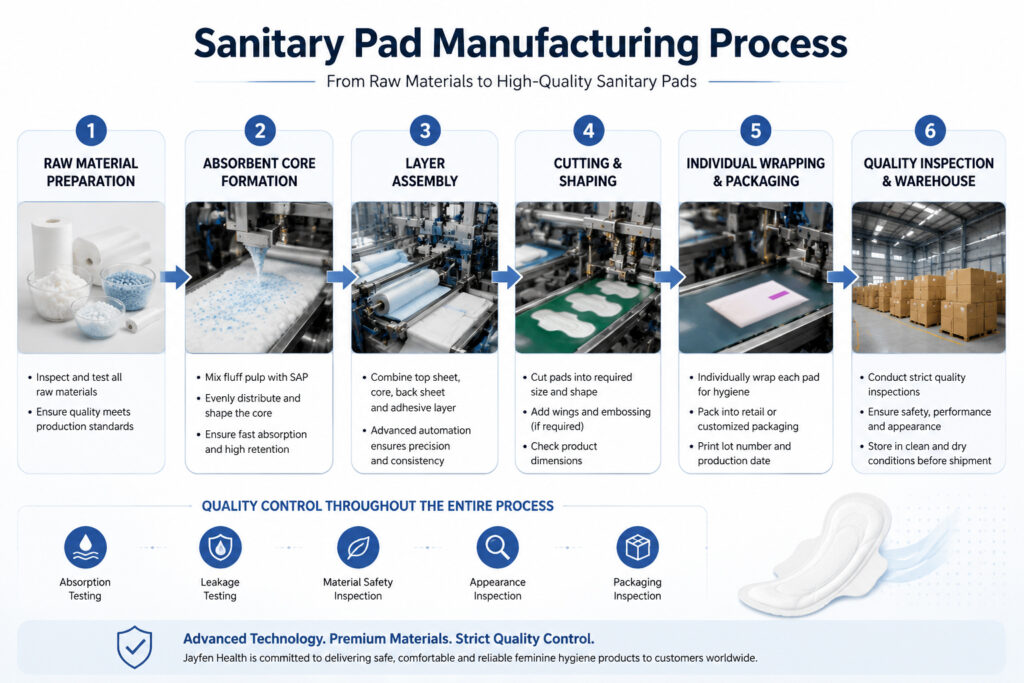
Modern sanitary pad production lines automatically combine different layers together, including:
Advanced equipment ensures accurate positioning and stable product quality throughout the manufacturing process.
After the pad structure is completed, the products are cut into different shapes and sizes according to customer requirements.
Manufacturers can customize:
Finished products are then individually wrapped and packed for shipment.
Quality control is an essential part of producing safe and reliable feminine hygiene products.
Professional manufacturers conduct inspections and tests, including:
Ensuring the sanitary pad can absorb and retain liquid effectively.
Evaluating the product’s ability to prevent leakage during use.
Checking raw materials to ensure safety and consistency.
Reviewing product appearance, packaging, and production quality before delivery.
For brands developing feminine hygiene products, selecting the right manufacturing partner is important.
A professional OEM sanitary pad manufacturer should provide:
Modern production facilities and experienced teams ensure stable supply and consistent quality.
OEM partners should support:
A strong quality system helps ensure products meet customer expectations and international market requirements.
Jayfen Health is a professional hygiene products manufacturer based in Malaysia, specializing in:
With experienced manufacturing capabilities and OEM expertise, Jayfen Health supports brands and distributors worldwide with:
From product development to mass production, we work with partners to create high-quality hygiene products for global markets.
The process of making sanitary pads involves advanced production technology, carefully selected materials, and strict quality control. Every step, from raw material preparation to final packaging, plays an important role in delivering safe and comfortable feminine hygiene products.
If you are looking for an experienced OEM sanitary pad manufacturer, Jayfen Health is ready to support your brand with professional manufacturing solutions.

When choosing absorbent hygiene products, many people wonder about the difference between incontinence pads and sanitary pads. Although they may look similar, these two products are designed for completely different purposes.
A sanitary pad is mainly used for menstrual protection, while an incontinence pad is specially developed for bladder leakage and urinary incontinence management.
Choosing the right product based on your specific needs can provide better absorption, improved comfort, better skin protection, and greater confidence in daily life.
The key difference between an incontinence pad vs sanitary pad is the type of fluid they are designed to absorb.
Sanitary pads are feminine hygiene products designed to absorb menstrual blood during a woman’s period.
Menstrual flow usually occurs gradually and has a thicker consistency compared with urine. Therefore, sanitary pads are developed with absorbent materials suitable for menstrual protection.
Sanitary pads are commonly used for:
For users who need protection during menstruation, sanitary pads provide comfort and reliable coverage.
Incontinence pads are designed specifically for people experiencing urine leakage or bladder control issues.
Unlike menstrual flow, urine can be released suddenly and quickly. This requires a different absorbent structure that can rapidly absorb liquid and lock moisture away.
Incontinence pads are suitable for:
For people looking for the best pad for bladder leakage, choosing a product designed specifically for urine absorption provides better protection than using a standard sanitary pad.
Choosing the right product depends on your personal needs and the type of protection you require.
The first step in how to choose an incontinence pad or sanitary pad is understanding your situation.
You need protection from:
A sanitary pad is designed to manage menstrual flow comfortably and effectively.
You need protection from:
An incontinence pad provides faster absorption and better moisture control because it is designed specifically for urinary leakage.
Absorbency is one of the most important factors when selecting hygiene products.
Sanitary pads are available in different sizes and absorbency levels depending on menstrual flow.
Users can choose products based on:
Incontinence pads are available in different absorbency levels based on the severity of leakage.
Users may need different levels of protection depending on:
Selecting the correct absorbency level helps prevent leakage and improves wearing comfort.
Comfort is another important factor when choosing between an incontinence pad and sanitary pad.
Incontinence pads are designed with technologies such as:
These features help keep the skin dry and reduce discomfort caused by prolonged moisture exposure.
Sanitary pads focus mainly on menstrual comfort and protection. They are not designed to handle sudden urine flow or provide long-term urine odor control.
One of the most common questions is:
Can you use a sanitary pad for incontinence?
For very occasional and light leakage, a sanitary pad may provide temporary protection.
However, sanitary pads are not designed for urinary leakage. They may not absorb urine quickly enough, which can lead to:
For regular bladder leakage, an incontinence pad is a better choice because it is specifically designed for urine absorption and protection.
With the increasing demand for personal care and healthcare products, choosing suitable urinary incontinence products has become increasingly important.
A high-quality incontinence pad should provide:
Quickly draws urine away from the skin and into the absorbent core.
Helps prevent leakage during movement and daily activities.
Maintains dryness and reduces irritation caused by moisture.
Allows users to continue daily activities without worrying about unexpected leaks.
When comparing incontinence pads vs sanitary pads, the best choice depends on your specific needs.
Although they may look similar, their absorbent technology and intended use are different.
Understanding the difference between incontinence pads and sanitary pads helps consumers make better choices and find the right protection for their lifestyle.
At Jayfen Health, we specialize in developing reliable hygiene solutions, including sanitary pads, incontinence pads, nursing pads, and other personal care products, helping global partners provide high-quality products for different consumer needs.